When you create a file for a collection in CloudCannon, it is saved at a path generated from a configured pattern. These patterns are called "Create Paths". You can use these to keep your content files organized as your Organization Members create them.
Create Paths are templates with a mixture of literal text and placeholders.
Placeholders are dynamic parts of the create path that are replaced when saving the file. They are defined between these pairs of brackets: [ ] and { }.
To change a create path:
- Open your global configuration file.
- Add create to a
collections_configorschemasentry.
Examples#
Using the slugified title from inside the new file's front matter (or data):
collections_config:
  pages:
    create:
      path: '[relative_base_path]/{title|slugify}.md'
{
"collections_config": {
"pages": {
"create": {
"path": "[relative_base_path]/{title|slugify}.md"
}
}
}
}The example above is the default value for create if not configured.
If you are only setting the path inside create, you can set it directly as a string instead of an object:
collections_config:
  pages:
    create: '[relative_base_path]/{title|slugify}.md'
{
"collections_config": {
"pages": {
"create": "[relative_base_path]/{title|slugify}.md"
}
}
}Using various data from new file's front matter (or data):
collections_config:
  archives:
    create:
      path: '[relative_base_path]/my-folder/{date|year}-{title|slugify}.md'
{
"collections_config": {
"archives": {
"create": {
"path": "[relative_base_path]/my-folder/{date|year}-{title|slugify}.md"
}
}
}
}Using a fixed filename and a data-dependent folder:
collections_config:
  main_pages:
    create:
      path: '[relative_base_path]/pages/{slug|deburr|slugify}/_index.md'
{
"collections_config": {
"main_pages": {
"create": {
"path": "[relative_base_path]/pages/{slug|deburr|slugify}/_index.md"
}
}
}
}Defining a filename data placeholder based on date and title, then slugifies that to remove the potential leading hyphens when date is unset (slugify removes leading and trailing hyphens):
collections_config:
  posts:
    create:
      extra_data:
        filename: '{date|year}-{date|month}-{date|day}-{title}'
      path: '[relative_base_path]/{filename|slugify}.[ext]'
{
"collections_config": {
"posts": {
"create": {
"extra_data": {
"filename": "{date|year}-{date|month}-{date|day}-{title}"
},
"path": "[relative_base_path]/{filename|slugify}.[ext]"
}
}
}
}Entries in extra_data are processed before path. They are accessible as data placeholders in path.
Overriding the default Create Path for a specific schema only:
collections_config:
  posts:
    schemas:
      default:
        path: schemas/post.md
      news:
        path: schemas/post-news.md
        create:
          path: news/{date|year}/{slug}[count].md
{
"collections_config": {
"posts": {
"schemas": {
"default": {
"path": "schemas/post.md"
},
"news": {
"path": "schemas/post-news.md",
"create": {
"path": "news/{date|year}/{slug}[count].md"
}
}
}
}
}
}Escaping brackets to use them in your output path:
collections_config:
  pages:
    create:
      path: '{section}/\[slug\].js'
{
"collections_config": {
"pages": {
"create": {
"path": "{section}/\\[slug\\].js"
}
}
}
}Placeholders#
Create Paths have a number of placeholders available. There are two types of placeholders: file and data placeholders.
File placeholders are always available, are surrounded with [ ] brackets, and relate to the original file path the editor was opened at:
[slug]is the original filename, excluding extension. Is an empty string if this results in “index”.[filename]is the original filename, including extension.[ext]is the last extension of the original file path.[relative_path]is the full original file path, relative to the collection path.[relative_base_path]is the original path excluding filename, relative to the collection path.[full_slug]is an alias for[relative_base_path]/[slug].[count]becomes a hyphen and number if the processed file path clashes with an existing file (e.g.file-1.md)
Data placeholders are populated from front matter or data values in the editor. They are surrounded with { } brackets. Here are some examples:
{title}is the title from inside the file.{id}is the id from inside the file.{title|lowercase}is title from inside the file, lower cased.{category|slugify}is category from inside the file, slugified.{tag|slugify|uppercase}is tag from inside the file, slugified, then upper cased.{date|year}is date from inside the file, with the 4-digit year extracted.{date|month}is date from inside the file, with the 2-digit month extracted.{date|day}is date from inside the file, with the 2-digit day extracted.
Data placeholders support a number of filters. They are placed after a |, and multiple filters can be applied in sequence.
uppercasetransforms text to uppercase.lowercasetransforms text to lowercase.deburrconverts Latin-1 Supplement and Latin Extended-A letters to basic Latin letters and removes combining diacritical marks.slugifyconverts non-alphanumeric characters into hyphens, then collapses sequential hyphens, then removes leading/trailing and hyphens.yearextracts the 4-digit year extracted from a date.monthextracts the 2-digit month extracted from a date.dayextracts the 2-digit day extracted from a date.
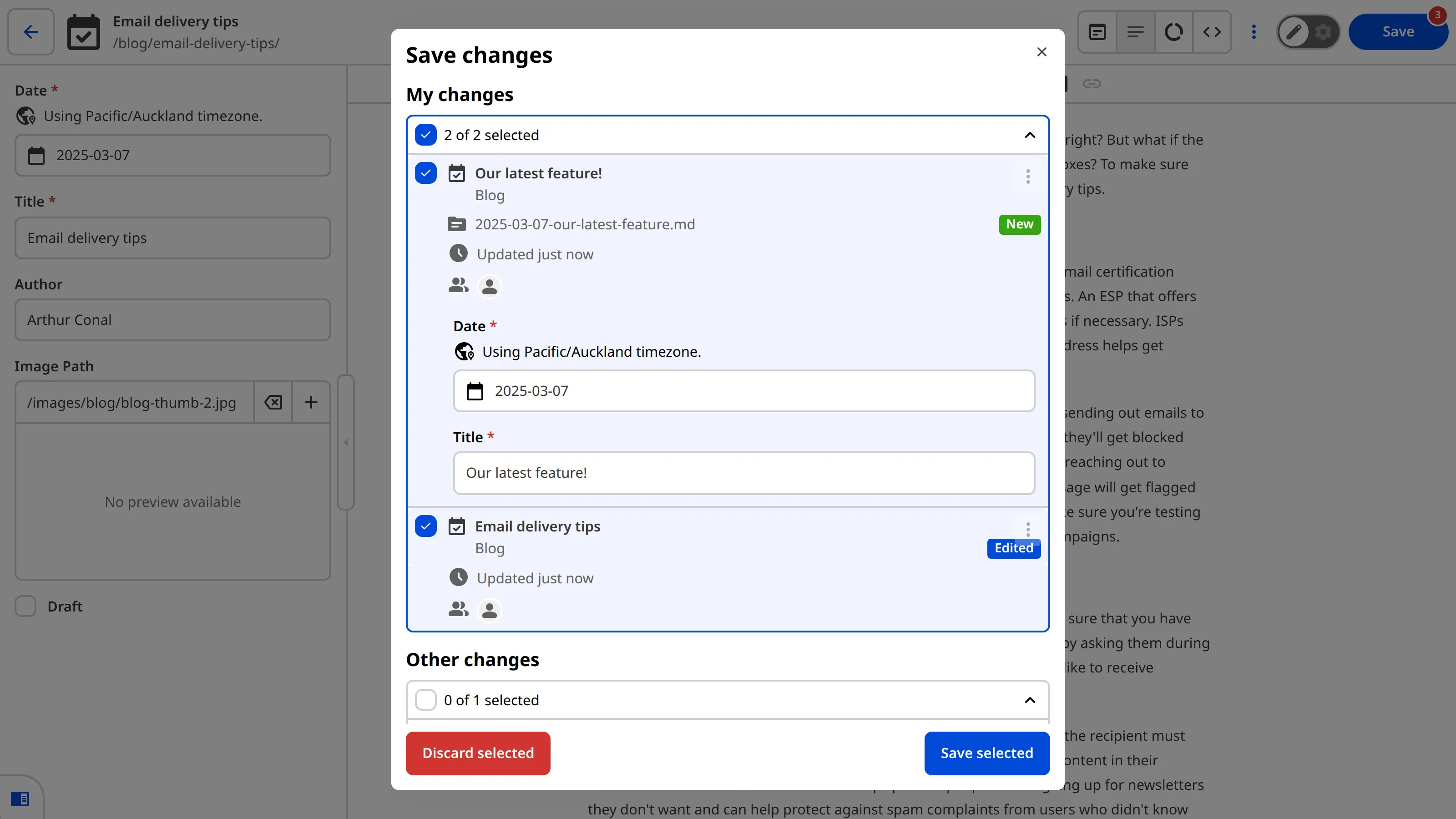
Each data placeholder used in the Create Path adds an input to the save confirmation modal.
Changing the inputs in the save confirmation modal will also update those values in your data/front matter if those inputs are also present there.
Options#
Create Paths have the following options available:
This key defines additional data placeholders for use in create path templates.
The value is an object where each property is a string that specifies a data placeholder. Entry values follow the same format as path, and are processed sequentially before path. These values are not saved back to your file.
For more information, please read our documentation on Create Paths.
Appears in: create.
Show examplesHide examples
In this example, we have configured extra data placeholders to generate a filename from date and title fields for use in the create path.
collections_config:
  blog:
    create:
      extra_data:
        filename: '{date|year}-{date|month}-{date|day}-{title}'
      path: '[relative_base_path]/{filename|slugify}.[ext]'
{
"collections_config": {
"blog": {
"create": {
"extra_data": {
"filename": "{date|year}-{date|month}-{date|day}-{title}"
},
"path": "[relative_base_path]/{filename|slugify}.[ext]"
}
}
}
}This key represents an individual extra data property in the create.extra_data object.
The value is a string that specifies a data placeholder for use in create path templates. Entry values follow the same format as path, and are processed sequentially before path. These values are not saved back to your file.
Appears in: create.extra_data.
Show examplesHide examples
In this example, we have configured an extra data property filename that combines date and title fields for use in the create path.
collections_config:
  blog:
    create:
      extra_data:
        filename: '{date|year}-{date|month}-{date|day}-{title}'
      path: '[relative_base_path]/{filename|slugify}.[ext]'
{
"collections_config": {
"blog": {
"create": {
"extra_data": {
"filename": "{date|year}-{date|month}-{date|day}-{title}"
},
"path": "[relative_base_path]/{filename|slugify}.[ext]"
}
}
}
}This key defines the raw template to be processed when creating files. Relative to the containing collection's path.
Appears in: create.
Show examplesHide examples
In this example, we have configured a create path template for the blog Collection using the date and title fields.
collections_config:
  blog:
    create:
      path: '[relative_base_path]/{date|year}-{date|month}-{date|day}-{title|slugify}.[ext]'
{
"collections_config": {
"blog": {
"create": {
"path": "[relative_base_path]/{date|year}-{date|month}-{date|day}-{title|slugify}.[ext]"
}
}
}
}This key defines a target collection when publishing.
When a file is published, the target collection's create definition is used instead.
Appears in: create.
The create entry is part of the configuration cascade, extending the number of relevant options available:
_inputs_select_data_structures
collections_config:
  posts:
    create:
      path: news/{date|year}/{slug}[count].md
      _inputs:
        date:
          comment: Use the starting date here
        slug:
          comment: This is used for your filename
{
"collections_config": {
"posts": {
"create": {
"path": "news/{date|year}/{slug}[count].md",
"_inputs": {
"date": {
"comment": "Use the starting date here"
},
"slug": {
"comment": "This is used for your filename"
}
}
}
}
}
}